
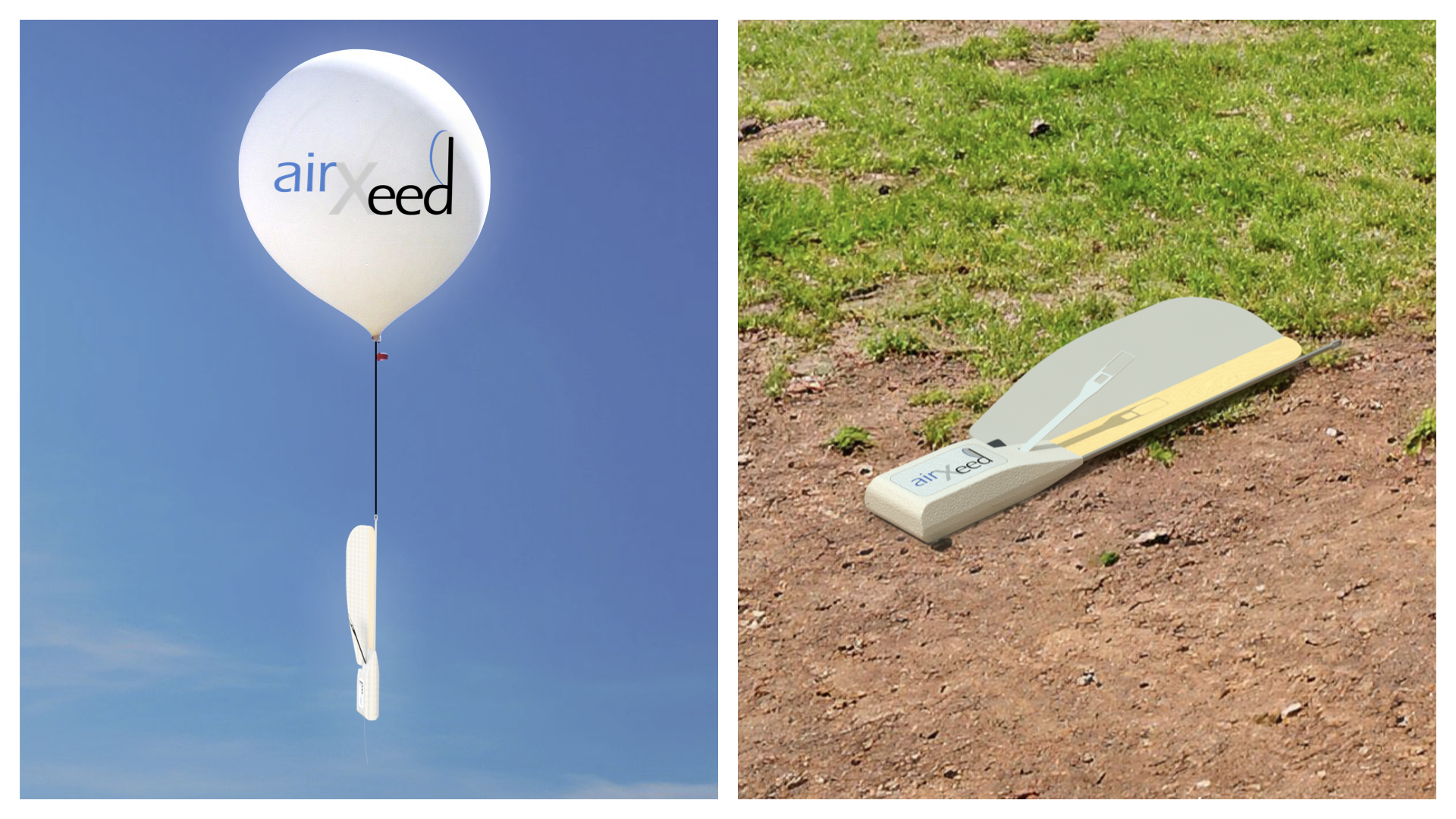
Current single-use radiosondes pollute the environment and cost $520,000 daily in global weather detection. Our nature-inspired design guides radiosondes back for reuse, reducing environmental impact and costs, offering a sustainable alternative.
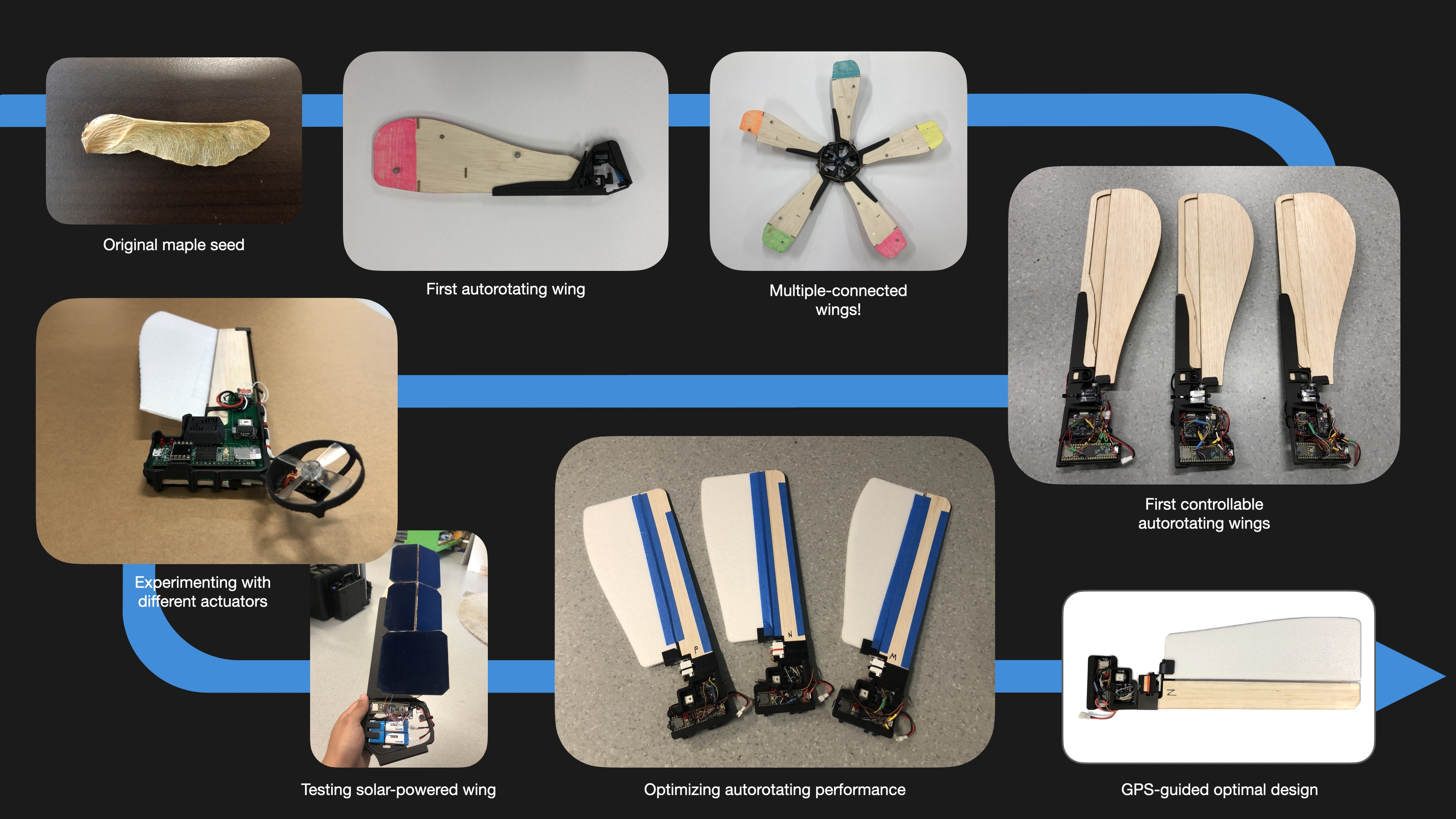
Our inspiration comes from the natural autorotation of falling maple seeds, evolved to disperse seeds effectively. Mimicking their gliding motion, we achieve a passively stable flight ensuring a slow descent, unlike parachutes which risk entanglement. Adding clever engineering techniques, we aim to make radiosondes reusable, reducing environmental pollution. With global warming and rising sea levels, it is crucial to consider our environmental impact. Our nature-inspired approach offers a sustainable solution for minimising the weather industry’s footprint.
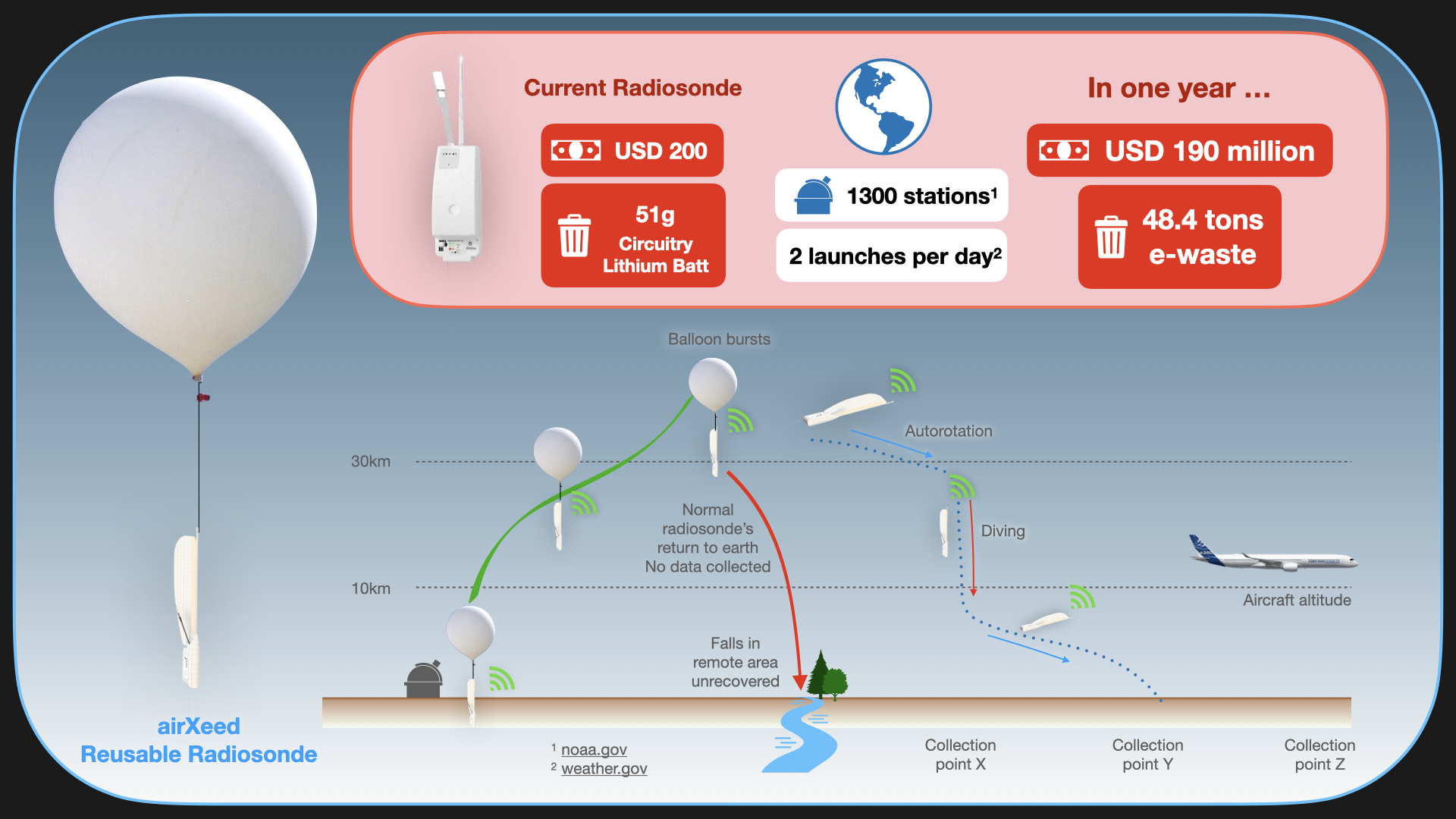
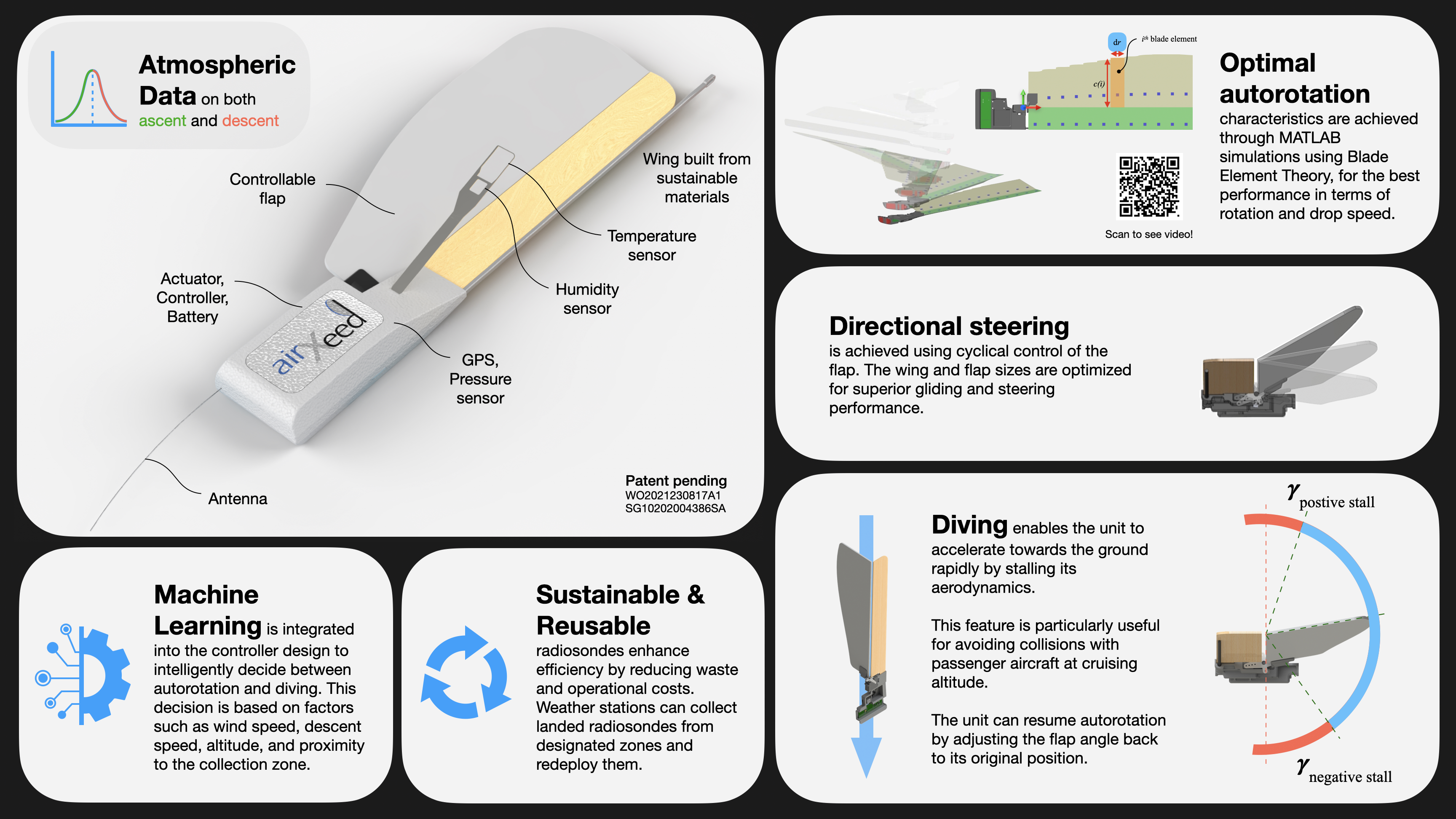
Weather balloons launch radiosondes twice daily to capture crucial atmospheric data unattainable by ground instruments, such as temperature, humidity, pressure, and wind conditions at various altitudes. At 30km altitude, the balloon bursts due to the thin atmosphere, and the radiosonde falls back to Earth. In conventional scenarios, it descends with a drag chute, collecting data only during ascent and none during descent. Our nature-inspired design allows it to glide back in autorotation, with a controllable flap for precise steering. It can even switch to ‘dive’ mode to avoid collisions with manned aircraft. An onboard controller using machine learning ensures soft landings at designated collection points, transmitting valuable data throughout both ascent and descent phases. This enables weather stations to retrieve and reuse radiosondes, enhancing efficiency and sustainability. Watch this video to learn more
Our design process involved numerous iterations to perfect the autorotation capabilities inspired by maple seeds. We began with a simple, lightweight design that performs passive autorotation, prioritizing simplicity and cost-effectiveness with sustainable materials like balsa wood and foam. We then added a single actuator for directional steering by adjusting the wing’s aerodynamic lift during each spin. We explored various actuation methods and even considered integrating solar cells. Using extensive MATLAB simulations, we optimized the design for the best rotation and drop speeds, ensuring efficient glide and controllability. Through countless prototypes and real-life deployments, we refined our design and control mechanisms, incorporating GPS, a barometer, and a compass as navigation sensors, alongside machine learning for intelligent navigation towards collection zones. This rigorous, iterative process culminated in an elegant, single-actuator design that is both highly effective and sustainable. Read more about our design process in our research article
Traditional radiosondes, costing about $200 each, are deployed via weather balloons to altitudes up to 30km. At these heights, the balloon bursts due to the thin atmosphere, and the radiosonde descends using drag chutes, primarily collecting data only during ascent. With over 2,500 radiosondes deployed daily worldwide, this results in an annual cost of US$190 million and generates over 48.4 tons of electronic waste. Our guided autorotation technology provides a revolutionary alternative. Radiosondes can now automatically navigate to nearby collection zones, gathering more data during descent and landing softly. Weather stations can collect and reuse these radiosondes, extending the sensors’ lifespan, reducing environmental impact and costs, and enabling comprehensive data collection during both ascent and descent. This enhanced data collection improves the accuracy and efficiency of weather monitoring.
免责申明:本文中部分图文内容转载自jamesdysonaward,相关版权归原作者及出处所有。若涉及post plant侵权,请及时联系我们,我们将第一时间删除处理。